Luc Delays Theo's Execution
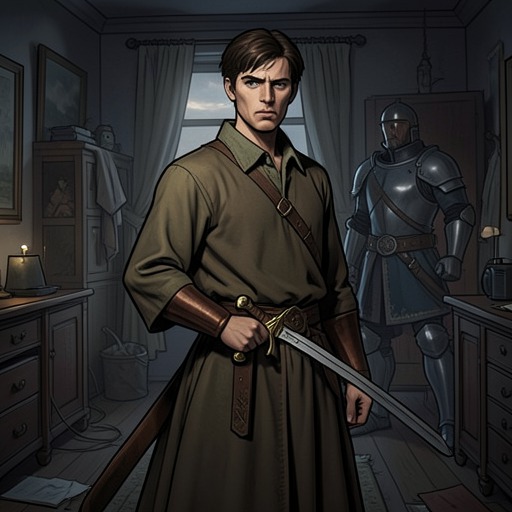
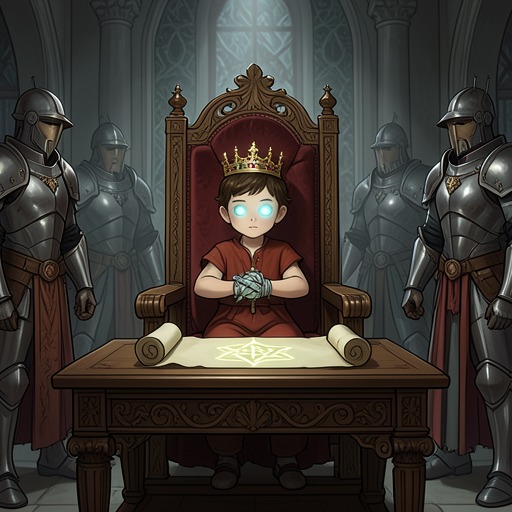
The Reincarnated Demon King's Host Just Wants to Live in Peace, But the Hero Won't Leave Him AloneLuc Delays Theo's Execution is the turning point of the trial of the Demon King's Host. Faced with the requirement that the Hero kill Malthios, Luc does not deny the danger represented by the Demon King, but refuses to let the court decide that Theo must die immediately. By choosing to live with Theo, supervise the Demon King, and leave execution for an undefined future after they have grown old together, Luc converts an apparently final sentence into a conditional postponement and makes a shared life the center of his understanding of justice, duty, and the future.
Causes and Background
The decision emerges from a conflict that has been building around Theo's concealed identity. Theo understands that friendship alone cannot save him if people discover what he is, and Cargo eventually asks whether he will tell the others that he is demon spawn. The question exposes the danger beneath Theo's ordinary life in Leafel: disclosure can turn a healer and neighbor into a condemned threat. When Bryony brings a portal from the capital to summon him to Luc's aid, Theo recognizes that entering the capital will end his autonomy. The court will learn who he is and where he lives, and Camden may identify him; the authorities could force him back into the Hero's party, where his secret might be exposed. He nevertheless goes because Luc may die, and Theo cannot accept a system that treats Luc as expendable and simply raises another child to replace him.
The trial therefore concerns more than whether Theo has committed a punishable act. The court has already placed his body under institutional control: a portal orb brings the party to the capital, magic-dampening handcuffs are fastened around his wrists, and he is taken to the dungeons. The court mage orders his imprisonment while Luc remains silent, and Theo cannot look at him as he is led away. The presence of Julius, Luc's former lover, among those involved in the proceedings intensifies the personal cost of the judgment. Theo's private relationship with Luc is being examined through a political system that has long treated the Hero as a function rather than as a person.
Luc's earlier history makes the court's expectations explicit. He describes previous lovers whose relationships could not survive the demands of the Hero's life: a maid in training from his youth, a squire who ended their relationship when Luc was announced as a departing Hero, and several later attachments that could not last when the party remained in towns for only a few months. Julius later tells Theo that Hero Eliza ordered him to reject Luc, threatening to take everything from him, because she wanted Luc to continue the Hero bloodline and sire the next Hero. The trial thus stands at the intersection of execution, compulsory service, heterosexual succession, and the inherited claim of the Hero institution over Luc's future.
The Trial and Malthios's Testimony
At the crucial moment, Luc asks Theo to let him speak to Malthios. Theo understands the danger of surrendering control and feels his fear sharpen, but Malthios tells him to trust him. Theo takes a breath and releases the Demon King. This act allows the court to hear directly from the being whose existence has been used to justify Theo's imprisonment and prospective execution.
Luc asks whether Malthios destroyed the demons. Malthios admits that he destroyed the Demon Fortress and everyone there, while acknowledging that a few lesser demons and demon-created monsters may still be loose. He nevertheless insists that nothing remains that competent adventurers could not handle and concludes that there is no longer any need for a Hero. The statement changes the practical stakes of the hearing: Malthios presents the destruction of the fortress as an act that has removed the immediate need for the heroic system, not as a plea that the court simply overlook his power.
Malthios also explains why he made that choice. He says that he never truly wanted to be the Demon King, though years of playing the role and witnessing his only real friends slaughtered by a Hero caused him to lose himself in it. His first motives were a return to power and revenge, but Theo reminded him what living meant and brought him back toward the person he had been before the crown was placed on his head. Theo gave him peaceful life, good food, and genuine friendship. Malthios therefore accepts responsibility for protecting Theo and Theo's world, even at the cost of his own life.
The testimony makes the host relationship morally legible without erasing the danger. Malthios is still the Demon King, and the court still has a reason to fear him, but his account establishes that the bond with Theo has altered his objectives. It also makes Theo more than a vessel to be destroyed. Theo is the person whose care and companionship have changed Malthios, while Malthios is a conscious participant in the decision to protect the world connected to Theo. Luc's later choice depends on recognizing both facts at once: the threat is real, but an immediate execution would also destroy a relationship that has produced the strongest available protection for Theo's world.
Luc's Conditional Sentence
After Malthios returns control to Theo, Luc asks for Theo back. He then announces that he has made his decision: as the Hero, it is his duty to kill the Demon King. The declaration appears to confirm the court's expected outcome, and Theo's heart freezes as Malthios's anger makes their fingers twitch. Khal, Veiv, and Wicker begin to move, expecting violence or an immediate attempt to defend Theo.
Luc interrupts that expectation by adding that he also chooses when the killing will occur. The distinction is the foundation of the event. Luc does not claim that the Hero's duty has disappeared, nor does he pretend that Malthios is harmless. Instead, he takes the timing of the sentence away from the court. He crosses the room, pulls Theo to his feet, and grips Theo's cold hands, turning a rule of execution into a decision governed by a future that the two of them will share.
Luc states that he will execute the Demon King only after they have had their years, their hair has gone grey, and they have lived their happily ever after. Until then, he will keep a close eye on the Demon King and his host. He proposes that he reside with them in a small northern village, away from the general population, where the arrangement will not alarm ordinary people. The plan is simultaneously intimate and political: Luc will remain a safeguard against Malthios, but that safeguard will take the form of cohabitation rather than separation, surveillance rather than immediate destruction, and an ordinary domestic future rather than endless heroic travel.
Luc then breaks the handcuffs with Hero strength. When the court mage protests that he cannot simply release the Demon King, Luc answers that Malthios is not being released in the ordinary sense. Theo is Malthios's prison, and Luc will be his humble guard; Luc also promises that Theo will never again be out of his sight. The image preserves the court's language of containment while radically changing its meaning. Theo is no longer an isolated prisoner in a dungeon, and Luc is no longer merely the executioner appointed by doctrine. Their relationship becomes the structure through which the danger is contained.
Leafel's Intervention and the Judgment
Luc's decision is made possible not only by personal love but also by collective witness. During the trial, Micah opens a large mirror spell from Leafel. Behind him stand Imani, Dale, Dmitri and his parents, Nib, Amaya, Hayden, and the people of Leafel. Hayden bows to the king and council and demands Theo's release on behalf of the town. Their appearance confirms that Theo's identity has not erased the bonds he formed as Healer Theo. The community does not abandon him when the capital calls him a demon king's host; it travels into the court's proceedings as a public body insisting that its healer be returned.
The contrast exposes the limits of the capital's justice. The court is prepared to classify Theo through his supernatural association and to resolve the problem through confinement and death, while Leafel judges him through years of care, friendship, and shared life. The town's intervention does not deny Malthios's existence or erase the need for vigilance. It demonstrates instead that Theo's social identity cannot be reduced to the legal category imposed upon him. Luc's choice gains ethical force because it is answered by a community willing to stand publicly beside Theo rather than leaving him to negotiate the court alone.
Eliza objects that the Hero's duty is to place the fate of the world above everything else and trusts Luc to honor that obligation. Luc's answer rejects her authority without denying the seriousness of the role. He tells her that choosing a quiet and peaceful life with the man he loves is the only choice he has ever made for himself. He also imagines a world in which those born with the Hero's gift can choose their fate instead of being bound to duty. The conflict therefore expands from Theo's sentence to the legitimacy of the Hero system itself: Luc refuses a structure that treats bloodline, service, and inherited command as more authoritative than personal consent.
King Alexis ultimately records the outcome as a formal judgment. The trial of Demon King Malthios ends with a sentence of life in prison, while Healer Theo Bladefoot is freed of all charges. The result is neither an uncomplicated acquittal of Malthios nor a conventional execution. Malthios remains subject to a punitive designation, but the sentence is rendered compatible with Theo and Luc's supervised life together; Theo, meanwhile, is cleared rather than condemned for protecting him. The cheers from Leafel through the mirror spell turn the legal conclusion into a communal reclamation, and Luc tells the townspeople that, if the roads are clear, they should arrive home before spring.
Significance and Aftermath
The event completes Luc's movement from a Hero defined by service into a person capable of choosing his own future. Earlier, his relationships were repeatedly shortened by departure, and the institution expected him to provide the next Hero through a prescribed bloodline. At the trial, he refuses both forms of dispossession. He will not surrender Theo to an abstract duty, and he will not allow Eliza to define his future through succession. His delay is therefore not passivity. It is an active reordering of priorities in which continued life, love, and consent become conditions for understanding what heroic responsibility should mean.
The decision also changes the meaning of Theo's secrecy and disclosure. Theo had expected discovery to end in coercion, imprisonment, and death, and the capital initially confirms those fears. Yet the disclosure brings three different responses into view: the court seeks control, Leafel offers public solidarity, and Luc chooses continued proximity instead of execution. The event does not make Theo's danger disappear; Malthios remains a condemned power within him, and Luc's promise of constant watchfulness acknowledges the continuing threat. What changes is the social and moral interpretation of the host bond. It becomes a relationship that must be managed, not a reason to erase the host.
The postponement also turns time into a form of resistance. The court imagines justice as immediate removal of danger, while Luc imagines a long interval in which he and Theo can live, grow old, and establish a peaceful home. The promised grey hair matters because it rejects the Hero system's compressed timeline of training, departure, service, reproduction, and replacement. Luc chooses a future that has no guarantee of being permanent, but that is still worth protecting. Execution is not denied forever; it is displaced beyond the life they intend to build, making the lived years rather than the sentence's final completion the decisive measure of their future.
Finally, Luc's choice gives the trial its lasting political significance. He remains willing to bear responsibility for Malthios, yet he refuses to reproduce the violence that made Malthios lose himself: the crown, the imposed role, and the killing carried out in the name of a larger order. By calling himself Theo's guard rather than Theo's executioner, Luc creates a provisional alternative to both unchecked demonic power and unquestioned heroic authority. The trial ends with Theo free, Malthios confined within a supervised shared life, Leafel publicly reunited with its healer, and Luc committed to a future in which the Hero's gift no longer automatically dictates the shape or ending of the person who bears it.